
County 9
The Turtle Is Back on County 9; Crew Paints Around It Again, Now by Policy
What was improvisation in June is procedure in July. The county’s line-painting crew met the snapper at the same bend, produced the same result, and this time had the paperwork for it.
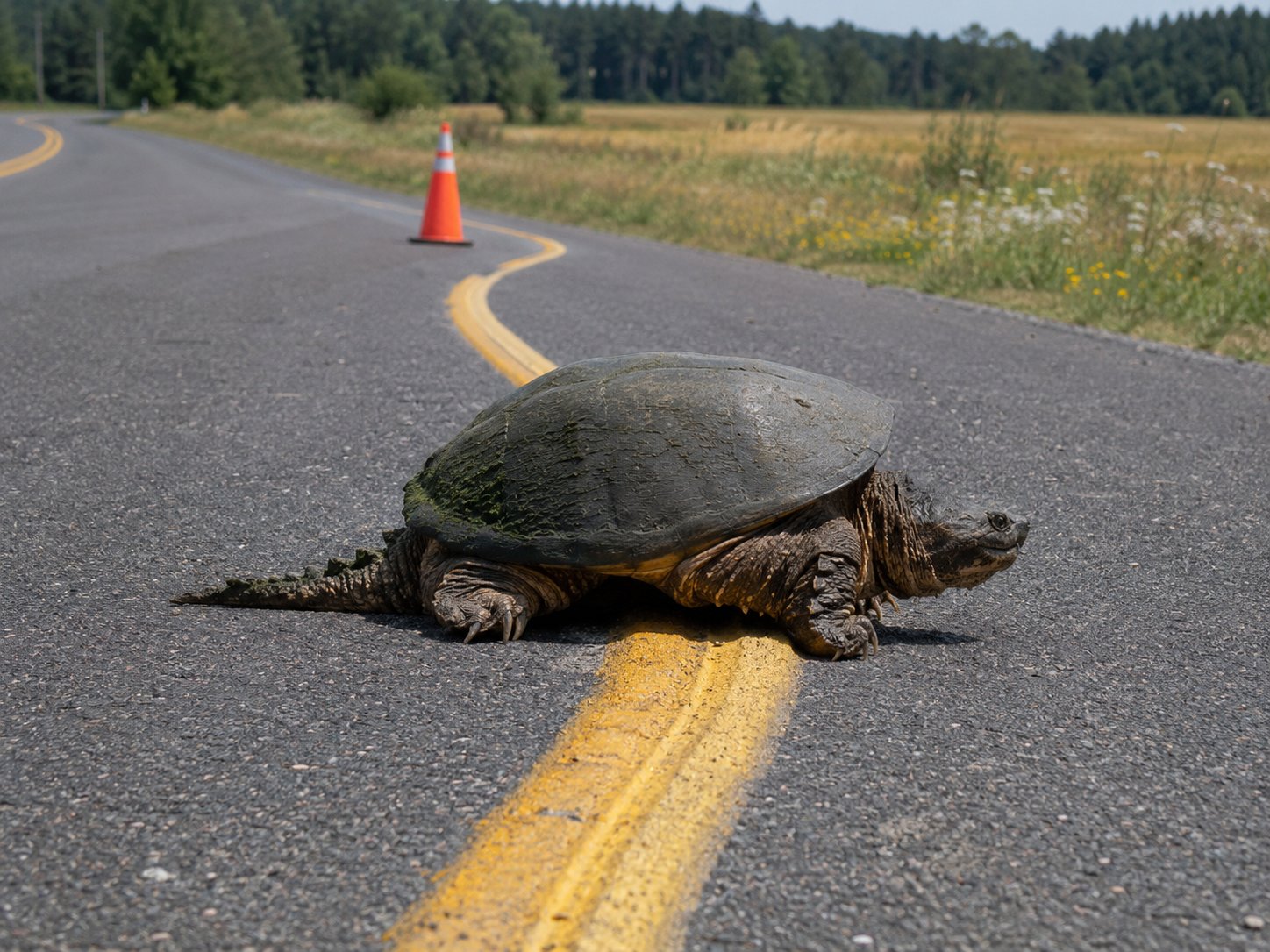
MISQUAH — The snapping turtle that stopped the county’s line-painting crew in June was waiting for them again last week, at the same bend of County 9, in what witnesses describe as the same posture and what the crew describes as the same mood. The crew did what it did before: painted up to the turtle, went around, and continued on, leaving a brief but distinct westward bulge in the fresh center line.
What has changed is the paperwork. Following June’s incident — which this newspaper covered, and which the town received with an enthusiasm the county did not entirely anticipate — the highway department has added a line to its field guidance. It reads, in full: “Paint around wildlife when practicable.” Foreman Gene Salo confirmed the language and its origin. “After last time, we figured we’d either get in trouble for it or get it written down,” Salo said. “It got written down. That’s the system working, far as I’m concerned.”
The turtle is believed to be the same turtle, on the grounds — offered independently by Salo, by a conservation officer, and by two residents of the bend — that no other turtle would dare. It is a snapper of considerable size and, per Officer Dan Roux, considerable age. “That animal has been crossing that road longer than the road’s had a line on it,” Roux said. “She’s not in the road. The road is in her yard.”
The crew waited a period described as “respectful” for the turtle to move, deployed the department’s single traffic cone, and proceeded when it became clear that the turtle regarded the standoff as a lifestyle. Total delay: eleven minutes. Total incident cost, per Salo: “one coffee break, redistributed.”
The June bulge in the line, it should be noted, has become something of a landmark. Drivers familiar with the road are reported to slow at the bend whether the turtle is present or not, which the county concedes is more than any signage has ever accomplished there. There is no plan to straighten the line. “The paint says what happened,” Salo said. “Seems honest to leave it.” The department expects the turtle again next summer, and has, for the first time in its history, budgeted for it.