
City Council
Eighteen Houses, One Pasture, and the Most Crowded Room in Misquah Since the Lutefisk Vote
A developer from the Cities wants to build the largest subdivision in town history on the old Hagen pasture. Monday’s meeting ran two hours and settled nothing — which several residents called the point.
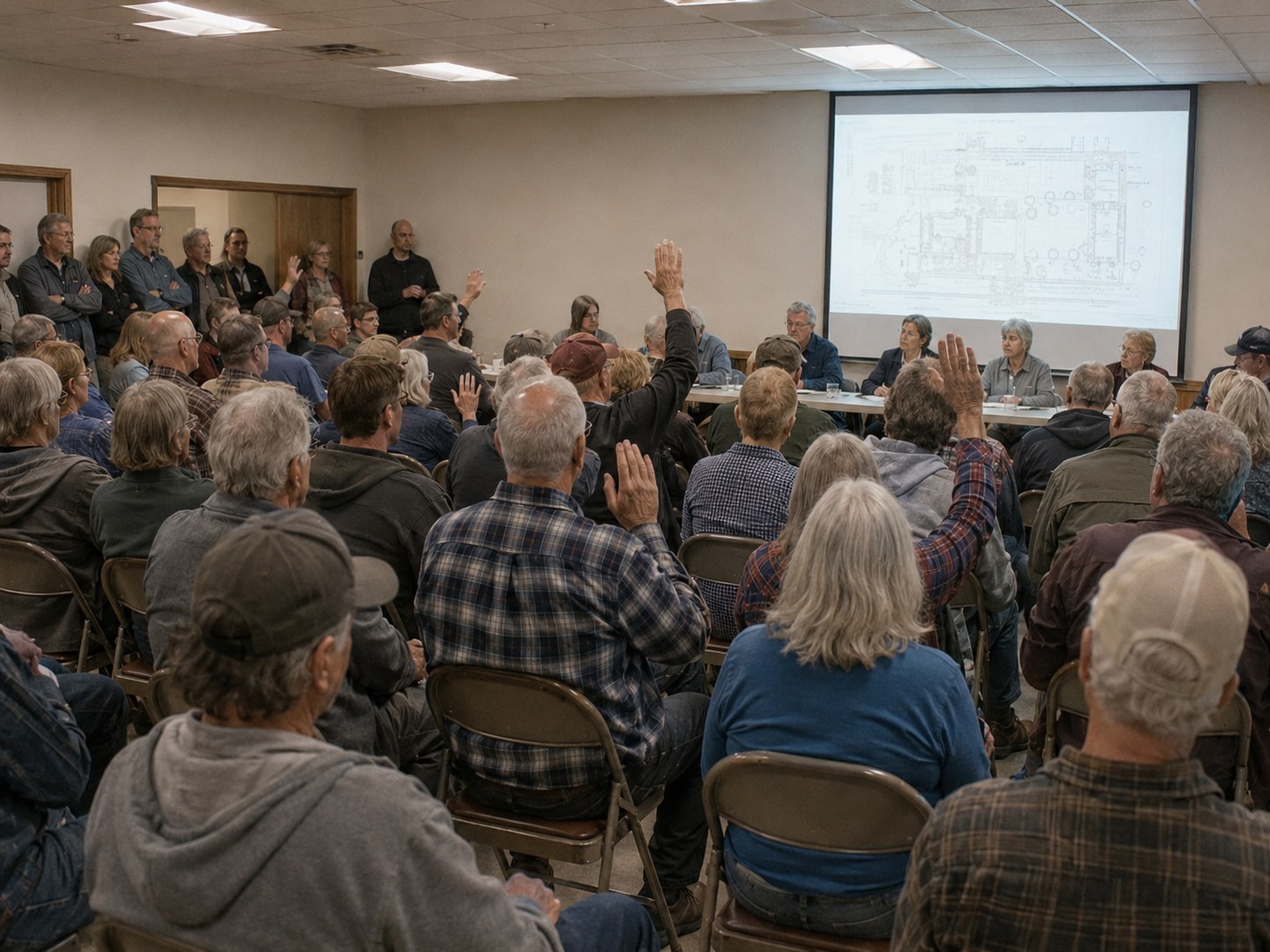
MISQUAH — There were not enough chairs. By 7:10 Monday evening the folding chairs at the Misquah city hall were full, the standing room along the back wall was full, and Clerk Donna Skoglund had propped the door to the hallway, where another dozen residents listened to a presentation they could mostly hear about a proposal that would, if approved, change the southern edge of town for good.
The plan, brought by North Pine Land & Homes of Plymouth, would put eighteen single-family lots on the old Hagen pasture, the forty-one-acre parcel south of the cemetery that the Hagen family farmed for three generations and sold last fall. Project manager Kevin Stang described modest two- and three-bedroom homes priced, he said, “from the high twos to the mid-threes” — $270,000 to $350,000 — on lots averaging just under an acre, served by a new cul-de-sac off County Road 7 and by city water and individual septic.
It would be the largest single development in the city’s history. Misquah has added, by Skoglund’s count, fourteen new houses total in the last twenty years. Eighteen at once is not an increment; it is a decision, and the room appeared to understand it as one.
The case for it is a case the whole region has been making for a decade. “We say every year that we’re losing our young people, that there’s nowhere for a young family to buy,” said Amber Lindgren, 31, who rents on Third Avenue with her husband and two children and spoke in favor. “Well, here’s somewhere. You don’t get to want young families and not want the houses they live in. Those are the same thing. They’ve always been the same thing.”
The case against it was not, mostly, a case against houses. It was a case against speed, and water, and a particular pasture. Dorothy Knutson, of the Mud Lake Association, asked who had studied whether eighteen new septic systems and eighteen new wells would draw down the shallow aquifer the south end shares. “Nobody at this table can tell me tonight,” she said, “and I’d like that on the record.” It went on the record. Others raised the two sandhill cranes that have nested in the pasture’s low corner for as long as anyone has watched, and the traffic the cul-de-sac would feed onto a County Road 7 that meets Main at the town’s lone, contested, four-way question.
Mr. Stang, for his part, said the firm had built in “nine comparable communities” and was prepared to fund a well-capacity study, a drainage plan, and a buffer along the pasture’s wet corner. “We’re not here to fight the town,” he said. “We’re here to sell houses, which works a lot better if the town likes us.”
Alderman Pete Hagen, whose late uncle had farmed the parcel, left the table and the room for the discussion, a recusal Mayor Gloria Vik noted for the minutes and several residents noted approvingly. The council took no action, referring the matter to the planning commission, which set a public hearing for July 14. “Nothing is decided tonight,” Mayor Vik told the crowd, “and I know some of you came here hoping it would be, and some of you came here terrified it would be, and I’m sorry to disappoint both groups equally.”
She thanked the room for the turnout — “the most people we’ve had in here since the lutefisk vote” — and reminded everyone that the hearing would be open, the comment period real, and the pace, as ever, deliberate. “This town does not do anything quickly,” she said, to knowing laughter. “It’s the thing people complain about, and it’s the thing that’s going to give us time to get this right.” Written comment may be left with Clerk Skoglund before July 14.