Independence Day
Misquah Puts a Parade on the Water; the First Fourth of July Flotilla Sets Out Saturday
Twenty-six boats have registered for the inaugural lap of Big Pelican — a tradition the town invented in a church basement last December and has been arguing about, gently, ever since.
MISQUAH — The idea for a boat parade was born in the basement of First Lutheran on the second Tuesday of last December, before eleven people, a thermos of coffee, and one question that took the better part of two hours to settle: whether a town that already has a parade needs another.
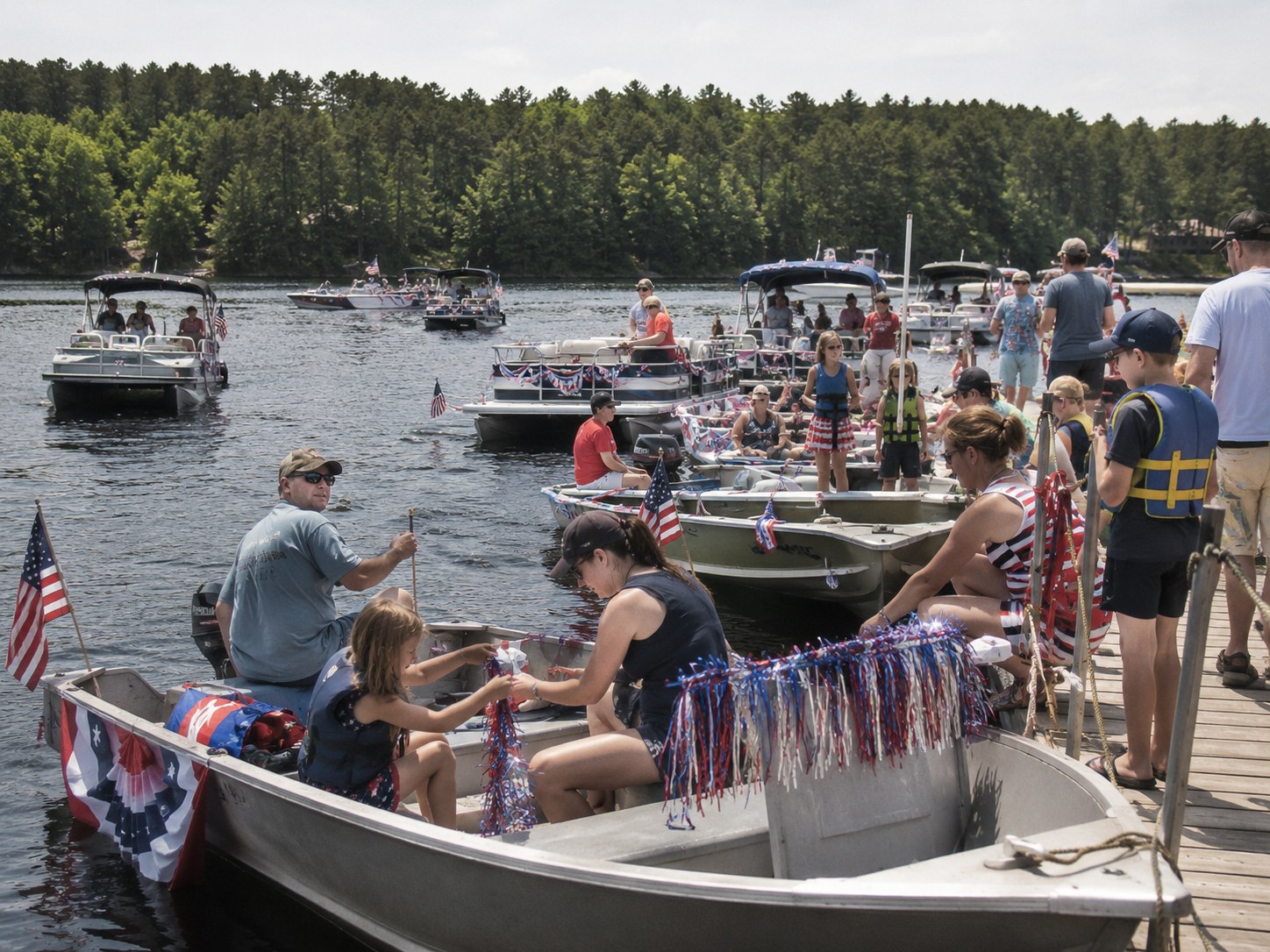
It decided, narrowly, that it does. At noon on Saturday the first Misquah Fourth of July Boat Parade will push off from the Loon Lake public landing and make a slow, counterclockwise lap of Big Pelican — twenty-six boats registered as of Monday, from a twenty-eight-foot pontoon down to a single aluminum canoe, in what the celebration committee is calling, without quite defining its terms, “the biggest thing to happen on the Chain that didn’t involve a fire.”
The land parade has gone up Main Street every Fourth since 1946, and nobody proposed replacing it; it will still step off at 9 a.m., north on Main, the one way the one street goes. The water parade is an addition, and the case for it, as committee chair Sandy Bergstrom put it, was less spectacle than arithmetic. “Half the town’s on the lake on the Fourth anyway,” she said. “We figured they might as well point the same direction for twenty minutes.”
Registration is free and will stay free; the only cost to entrants is the decorating, which is encouraged and, by unanimous and slightly defensive vote, not judged. “Judging leads to feelings,” Bergstrom said, declining to elaborate, in the manner of someone who has watched judging lead to feelings.
The route runs north along the Loon Ridge shore, around the island and back — a little under two miles, at a pace set by the slowest pontoon, which is to say no pace at all. A no-wake rule holds for the whole loop, a provision Alderman Lloyd Bunde, the council’s recognized authority on the conduct of watercraft, insisted on in January and has reaffirmed, unprompted, at every meeting since. “You can have a parade or you can have a wake, and you cannot have both,” Bunde said — a sentence he has delivered often enough that other members have begun mouthing it along with him.
The rule is not only decorum. The two loon chicks on the north end of Big Pelican, hatched in early June, still can’t dive away from a swell, and Greta Solberg, whose loon survey the library has certified as “actually science,” has asked the flotilla to give the far shoreline a wide, gentle berth. “They’ve made it this far,” she said. “Don’t be the boat.”
The fireworks are a separate operation, fired at dusk from the point below Loon Ridge under the volunteer fire department. Chief Gary Sundberg said the show runs about eighteen minutes and costs the celebration fund a little over four thousand dollars, most of it raised through the winter meat raffle at the Northern Tap — “which means,” he noted, “the Fourth of July is, technically, sponsored by raffled-off pork.” He asked that spectators keep back of the snow fence and that no one, again, bring “their own supplementary fireworks,” a reference everyone understood.
What it will actually look like, no one can say, it never having happened. Asked whether she was nervous, Bergstrom considered it honestly. “It’s twenty-six boats going in a circle,” she said. “If it works, we’ll do it again. If it doesn’t, we’ll have learned something, and we’ll still do it again.” Lineup is 11:30 at the landing. The fire truck will sound its horn once, at the start, and — organizers have asked the paper to make this clear — only once.